
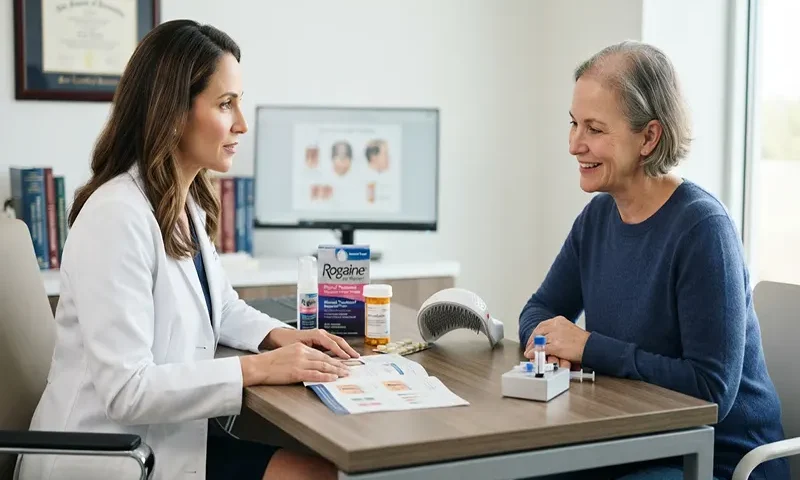
Experiencing hair thinning during or after the transition through menopause can feel deeply unsettling. Society often ties a woman’s identity, youth, and vitality to her hair, making the discovery of a widening part or a receding ponytail a profoundly emotional challenge. However, you are far from alone in this journey. Clinical data reveals that over 50% of women experience significant, noticeable hair loss by the time they reach age 50 to 60. Far from being a mere cosmetic nuisance, mature hair thinning is a medical reality driven by complex physiological shifts. Fortunately, modern dermatology offers a robust suite of FDA-approved and off-label medical interventions that can successfully halt loss and stimulate regrowth.
To address hair loss effectively, one must first understand its root causes. Unlike male pattern baldness, which typically manifests as a receding hairline and localized vertex balding, female pattern hair loss (FPHL)—clinically known as androgenetic alopecia—presents as diffuse thinning across the crown and top of the scalp. Women generally preserve their frontal hairline, but notice a widening part line and an overall reduction in ponytail density. The primary driver of this transition is the endocrine system. As women journey through perimenopause and menopause, ovarian function declines, precipitating a sharp drop in protective estrogen and progesterone levels. Relative to these declining female hormones, circulating androgens exert a more potent influence, shortening the anagen (growth) phase of the hair cycle and prematurely pushing follicles into the telogen (resting) phase, ultimately leading to follicular miniaturization.
Before embarking on any therapeutic regimen, the importance of a proper differential diagnosis cannot be overstated. A comprehensive evaluation by a dermatologist or trichologist is vital to rule out confounding variables. Diffuse hair shedding can mimic or coincide with nutritional deficiencies—such as critically low iron, ferritin, or Vitamin D—thyroid dysfunction, or autoimmune conditions like alopecia areata. Identifying the exact etiology ensures that your female pattern hair loss treatment is precisely targeted and safe.
Once a diagnosis of FPHL or age-related thinning is established, patients can explore a range of gold-standard topical and oral therapies. Minoxidil remains a foundational cornerstone of treatment. Available as topical solutions or foams in 2% and 5% concentrations, minoxidil works by widening blood vessels and opening potassium channels, which prolongs the anagen growth phase and delivers vital nutrients to localized hair follicles. For patients who find topical applications irritating, messy, or cumbersome, the clinical landscape has increasingly embraced low-dose oral minoxidil for women under strict medical supervision, offering systemic compliance and impressive efficacy.
In addition to minoxidil, anti-androgen medications are frequently prescribed to combat the hormonal drivers of miniaturization. Prescription options such as spironolactone, bicalutamide, or finasteride (utilized off-label for post-menopausal women) function by blocking androgen receptors or inhibiting the 5-alpha-reductase enzymes that convert testosterone into dihydrotestosterone (DHT). By shielding vulnerable follicles from androgenic damage, these systemic agents stabilize hair density and foster a healthier scalp environment.
Beyond pharmacological agents, advanced regenerative and procedural treatments have revolutionized dermatologist hair loss solutions. Platelet-Rich Plasma (PRP) therapy has emerged as a powerhouse for PRP for hair loss over 50. The procedure involves drawing a small amount of the patient’s blood, spinning it in a centrifuge to concentrate growth factors, and micro-needling or injecting the nutrient-rich plasma directly into the scalp. This bio-stimulation awakens dormant follicles, reduces local inflammation, and significantly enhances vascularization around the hair roots.
Another compelling in-office or at-home technology is Low-Level Laser Therapy (LLLT). Medical-grade laser caps, bands, and clinical panels utilize photobiomodulation at specific wavelengths—typically between 650 and 680 nanometers—to cellularly stimulate adenosine triphosphate (ATP) production within the mitochondria of hair cells. This cellular energy boost encourages metabolic activity and accelerates tissue repair. Furthermore, microneedling (or collagen induction therapy) is frequently employed either as a standalone treatment or as a synergistic partner to topical minoxidil. By triggering localized wound-healing cascades, microneedling upregulates growth factor expression and dramatically enhances the transdermal absorption of topical medications.
While medical interventions form the core of effective treatment, foundational holistic support, nutrition, and lifestyle modifications are equally crucial. Addressing menopause hair thinning requires adequate dietary protein intake and the correction of specific micronutrient gaps. Clinicians often look for zinc, biotin, optimal Vitamin D status, and ferritin levels maintained above 50 ng/mL. Additionally, managing chronic systemic inflammation and mitigating stress-induced cortisol spikes protects the delicate hair cycle from premature disruption. On a daily basis, women must adopt gentle hair-care practices, steering clear of high-tension styling, harsh chemical relaxers, and excessive heat to prevent traction alopecia and mechanical breakage on already fragile mature hair shafts.
Ultimately, managing hair loss over 50 requires patience, consistency, and a multi-modal approach tailored meticulously by a medical professional. Because hair follicles operate on a slow biological clock, visible improvements typically demand anywhere from six to twelve months of dedicated adherence.
If you are noticing changes in your hair density, take heart in knowing that you do not have to face it alone. Schedule a consultation with a board-certified dermatologist early to establish an accurate baseline, rule out underlying systemic imbalances, and customize a long-term therapeutic regimen. By combining evidence-based medical treatments with compassionate, expert care, you can successfully reclaim your confidence, restore your scalp health, and enjoy vibrant, resilient hair for years to come.

